










Know Your Nature Parks - Autumn 2026
As autumn settles in, on Phillip Island (Milawul), the busy shorebird breeding season begins to wind down. While some devoted parents are still tending eggs or guiding their fast-growing chicks, many birds are already starting to gather into winter flocks. Before long, these fledglings along with their parents will begin moving off the island in search of new feeding grounds.
At the same time, our long-distance travelers are getting ready for the journey of a lifetime. Shorebirds that rely on the incredible East Asian–Australasian Flyway can now be spotted darting across the low tide mudflats, feeding with urgency to fuel up for their epic migration to the Northern Hemisphere. Their determination is a powerful reminder of just how extraordinary these birds are. There’s plenty to celebrate from this year’s breeding season and our rewilding efforts - read on for the latest updates.
In the skies – Birdlife
Hooded plovers
Hooded plovers (Thinornis cucullatus cucullatus) are categorised as Threatened in Australia under the Environment Protection and Biodiversity Conservation Act 1999 and Vulnerable in Victoria under the Flora and Fauna Guarantee Act 1988.
To help the hooded plover throughout the 2025-26 breeding season, staff and volunteers carefully monitor nesting sites and collect vital data. When eggs are found, a nest refuge is installed, complete with signage, rope fences and in some locations shelters for chicks and nest monitoring cameras.
The ‘Sharing Our Shores’ campaign runs until April 30 and continues to raise community awareness about the importance of working together to protect the natural environment and vulnerable species like the hooded plover.
The 2025-26 hooded plover breeding season results so far are positive with nine fledglings recorded by mid-March and there is one nest remaining with two chicks.
The dedication of the ‘Hoodie Team’ made up by volunteers, the Nature Parks and Bass Coast Shire Council staff, Deakin intern students, Department of Energy, Environment and Climate Action Conservation Regulator Officers and the community is paramount to the protection of these tiny yet mighty birds.
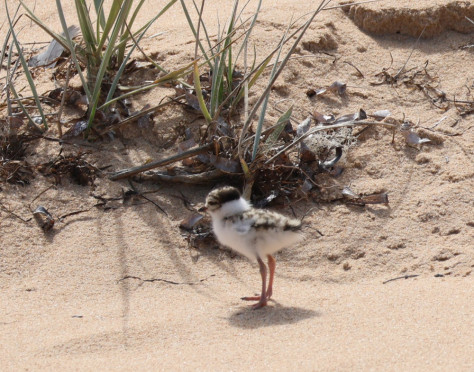
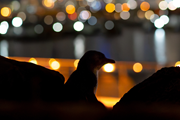
Image 1: Hooded plover chick.
In the water
Little penguins
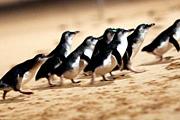
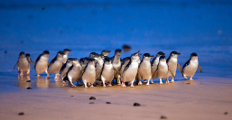
As we move towards the end of the little penguin breeding season on Phillip Island (Milawul), only a few late chicks remain in their burrows. Analysis of the breeding season is currently underway.
Many adult penguins have returned to sea to forage, building up vital body reserves in preparation for the annual moult, and across the colony, we’re now seeing penguins in various stages of the moult process, some looking scruffy and puffed-up with swollen flippers as new feathers push through, while others are already showing off a complete set of beautiful new blue feathers ready for the year ahead.
Although not all penguins breed every year, every adult penguin must undergo what is known as a ‘catastrophic moult’. The moult is a complete replacement of all their roughly 10,000 feathers over a period of a few weeks. For a species that spends 80% of their lives in the water it is a vital process to replace worn feathers and to maintain waterproofing.
Because the penguins lose waterproofing during this time, the birds must remain on land and cannot feed. They spend several weeks beforehand at sea, fattening up and in some cases nearly doubling their weight before coming ashore. This shift in season is reflected in our nightly parade counts, which have dropped from an average of 885 penguins per night in January to 389 per night in February.
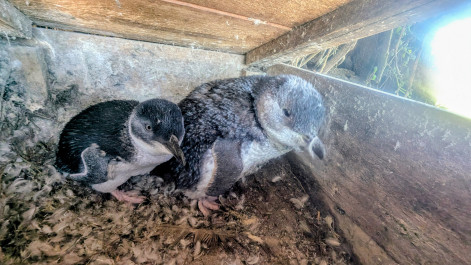
Image 2: A breeding pair in one of our study site nest boxes, the male in early stage of moult (right) and female almost complete (left).
On the ground
Eastern barred bandicoots
The Eastern barred bandicoot population on Churchill Island is now estimated at around 150 individuals, and their recovery continues to progress across Phillip Island (Milawul). Bandicoots have successfully expanded into bushland, farmland and even residential areas, with sightings reported in Ventnor, Newhaven, Smiths Beach and Rhyll.
Phillip Island Nature Parks staff and volunteers continue to carefully monitor this growing population, and recent reports show the bandicoots are steadily spreading, with an encouraging increase in sightings around Red Rocks and Rhyll.
The local community plays a vital role in the success of this program from planting native species to improve habitat quality, to supporting wildlife by being responsible pet owners, and slowing down on the roads at night.
You can help us track the population by reporting bandicoot sightings on our portal: ebb.natureparksresearch.com.au or by emailing.
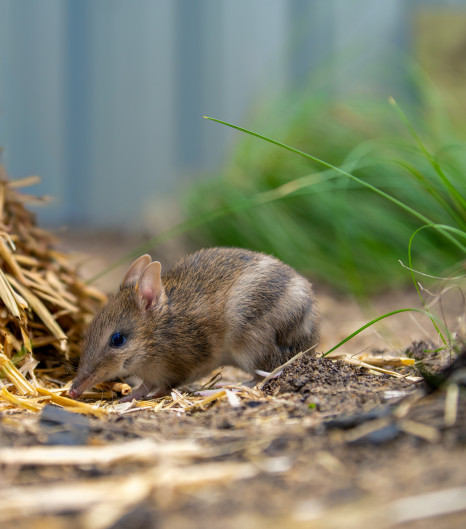
Image 3: Eastern barred bandicoot in care at the Wildlife Rehabilitation Centre
Woodland flora
The successful natural regeneration of an area excluded from rabbits and swamp wallabies in 2022 inspired the Reserves team to create another similar zone within the currant-wood (Monotoca glauca) habitat of Rhyll wetland. The team constructed a 750 sqm coop that includes several mature currant-wood, a stinkwood (Zieria arborescens) thicket and a coast manna-gum (Eucalyptus viminalis subsp pryoriana). As with the original exclusion zone however, the ground and small shrub layers were largely absent due to heavy browsing pressure by swamp wallabies and other herbivores.
After just six months, there has been evidence of currant-wood recruitment occurring, along with coast manna-gum, grass trigger-plant (Stylidium graminifolium), prickly guinea-flower (Hibbertia acicularis), common aotus (Aotus ericoides), grey parrot-pea (Dillwynia cinerascens), common heath (Epacris impressa) and many other small shrub and herb species. Spring monitoring also revealed several orchid species including large numbers of musk-hood orchids (Caladenia moschata), a significant number of slender sun orchids (Thelymitra pauciflora), a small patch of nodding greenhoods (Pterostylis nutans) and a single specimen of a new record for Milawul, tiny pink-fingers (Caladenia pusilla).
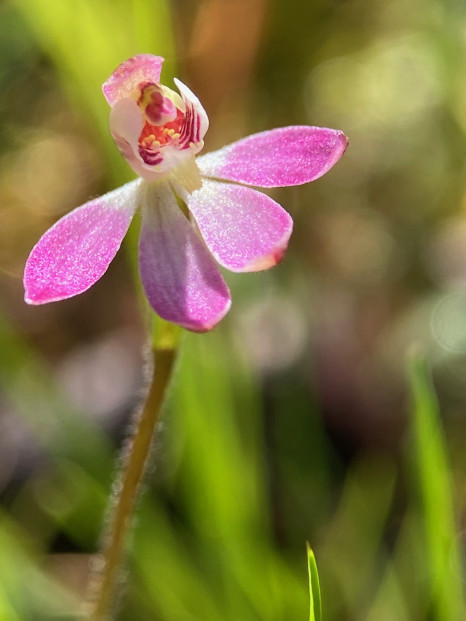
Image 4: Tiny pink-finger orchid.
After three and a half years, the original exclusion zone is thick with regenerated growth and species diversity. The currant-woods continue to thrive, with some of the regenerated plants now up to two metres high with developing flowers and fruit.
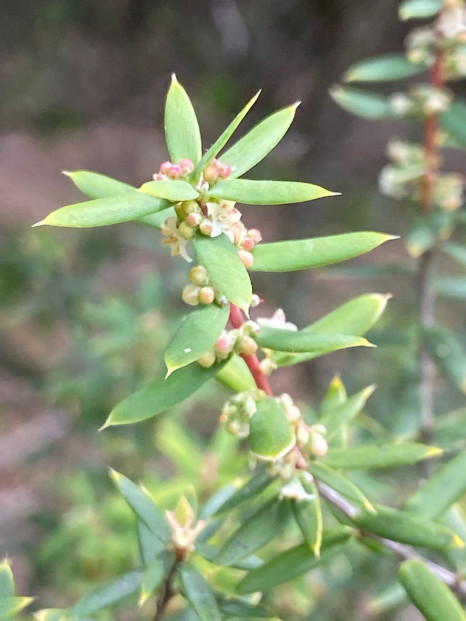
Image 5: Young currant-wood fruit.
Barb Martin Bushbank
The Barb Martin Bushbank team of staff and volunteers continue to make significant contributions to support habitat restoration across Phillip Island (Milawul) through the propagation and growth of native flora species. They are producing currant-wood plants from cuttings, and 20 plants have been introduced to suitable habitats near Newhaven wetland. After several months, all are doing well and showing new growth. If continued development and success prevail, further specimens can be installed in successive years to develop a robust community.
At the Koala Conservation Reserve woodland, 40 blue gums were planted along with 25 coast manna-gum (Eucalyptus viminalis subsp pryoriana) and 25 swamp gums (Eucalyptus ovata). These plant installations continue work that aims to restore the woodland canopy.
The Barb Martin Bushbank volunteer team are integral to the outputs at the native plant nursery. They contributed over 3000 hours in 2024-25, collecting seeds, propagating plants and potting up tens of thousands of seedlings. These seedlings support revegetation projects across the region completed by Bass Coast Shire Council, volunteer Coastcare groups and Phillip Island Landcare.
The nursery is open for retail sales on Wednesday, Thursday and Saturdays from 9.00 am to 3.00 pm for the local community and visitors to buy native plants for their gardens which provides habitat for wildlife.
Your Year to Volunteer
At the Nature Parks, we are fortunate to have support from a dedicated team of volunteers across a range of conservation, research, and tourism programs. While many roles have wait lists, we are anticipating vacancies in our Visitor Experience roles at Churchill Island, Koala Conservation Reserve and Penguin Parade from April and May this year. Volunteers play an important role in educating visitors to the Nature Parks about conservation and the work we do to protect nature for wildlife. Volunteers also share their knowledge of cultural and European history of Milawul. To learn more or sign up for an induction, visit penguins.org.au/about/work-with-us/volunteering/
Volunteers are required to register with Better Impact, our volunteer management database and complete online training modules. Volunteers must have a current Victorian Working with Children Check, and are required to commit to regular shifts. Ideally one shift per fortnight for at least 6–12 months. The Nature Parks has a great reward and recognition program for Volunteers including annual events, social activities, awards and more.
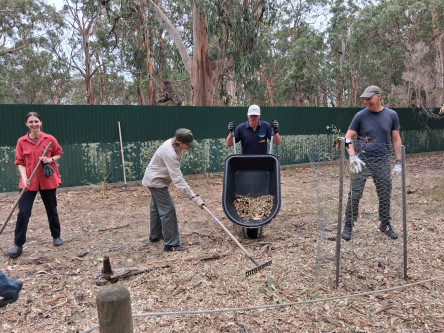
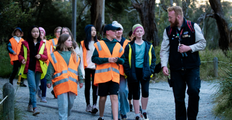
Image 6: Volunteers at a working bee at the Koala Conservation Reserve
For the locals
Summerland Peninsula Master Plan
We thank the community for your thoughtful feedback throughout the Summerland Peninsula Master Plan consultation period. We’re carefully reviewing all submissions to support the project to move into the next phase of writing a draft plan.
If you have any inquiries, you can email: community@penguins.org.au
Nobbies boardwalks
Phillip Island Nature Parks will be undertaking essential repairs at the Nobbies to extend the life of the boardwalks at this spectacular attraction. The upgrades will include high-level repairs to the substructure and ageing infrastructure to ensure ongoing public safety.
During this time, the majority of the boardwalks will remain open with viewing access to the blow hole, however a section of the boardwalk, with wheelchair access, will be closed. Please follow the directions of staff and signage on site.
These upgrades are part of a long-term capital works program and are an example of how eco-tourism directly funds the construction and maintenance of public assets. We thank the community for their understanding during these short-term closures.
On the way to soak up the views at the spectacular Nobbies boardwalks, visitors can stop at the Penguin Parade Visitor Centre, which opens from midday each day. There are café and retail services available and bathroom facilities.
Penguin Parade boardwalk toilets
Construction of Stage 3 of the Penguin Parade Boardwalk Redevelopment Project has commenced with works to upgrade the remaining boardwalk elements, building of new toilet amenities, viewing area and return boardwalk to the visitor centre.
The outdoor toilet facilities are unavailable until completion of the first phase of work, which is expected to be completed in February 2027.
The existing boardwalk toilets have been demolished and new state-of-the-art amenities will be built in the same location. Toilets will continue to be available in the visitor centre and at the bus car park.
We apologise for any inconvenience whilst this work is undertaken.
Smiths Beach (East) Stair and Ramp Upgrades
Phillip Island Nature Parks will deliver infrastructure upgrades at the eastern beach access to Smiths Beach.
Upgrades aim to improve access to the beach for ongoing lifesaving services and public use. Works address steel corrosion and deteriorating materials, maintenance upgrades to the accessible ramp, and the renewal of the stair and landing structure, adjacent to the Woolamai Beach Surf Life Saving Club rescue base. Funding from the Coastal Public Access and Risk Grant program 2024-25 and contributions from the Nature Parks will ensure this popular beach remains accessible and safe for community and visitors in the years ahead.
Closures are required during some periods of this work, however access to the beach remains via the main (western) beach access. Construction will commence May to prevent disruption during peak lifesaving season, with completion expected by August this year.
Support your Nature Parks
Dark Sky So Shearwater Fly
Autumn marks the departure of short-tailed shearwaters as they begin their long 15,000 km migration to the Bering Strait near Alaska. Their flight begins with a trip south to feed in the nutrient-rich waters around Antarctica before heading north. They leave their plump, fluffy chicks behind in the burrows where they lose weight and grow their adult flight feathers. By late April or early May, the chicks will also embark on their first migration.
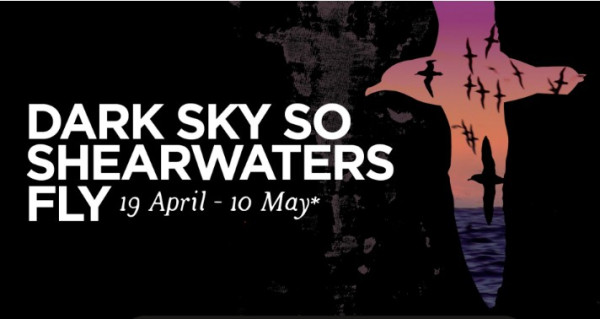
Support the 'Dark Sky So Shearwaters Fly' campaign to assist shearwater chicks' successful departure.
- Turn your outdoor lights off in the evening
- Consider using wildlife sensitive lighting at home
- Driving slowly and be cautious on the roads
If you find an injured shearwater, please call the Wildlife Victoria hotline 24/7 on 03 8400 7300.
Keeping Wildlife Wild
The greatest thing you can do for wildlife is to keep it wild. Please always maintain a safe distance and remember how lucky we are to be able to share our beautiful island home.
We’d love to see your images from around the Nature Parks
Don't forget to share your autumn images of the Nature Parks with us.
Tag us:
Instagram - @PhillipIslandnp
Facebook - PhillipIslandNatureParks
#PhillipIslandNP