














Conservation News - winter 2026
Positive action for a biodiverse future
Wumindjika (Welcome)
A message from Shael Martin, General Manager Conservation
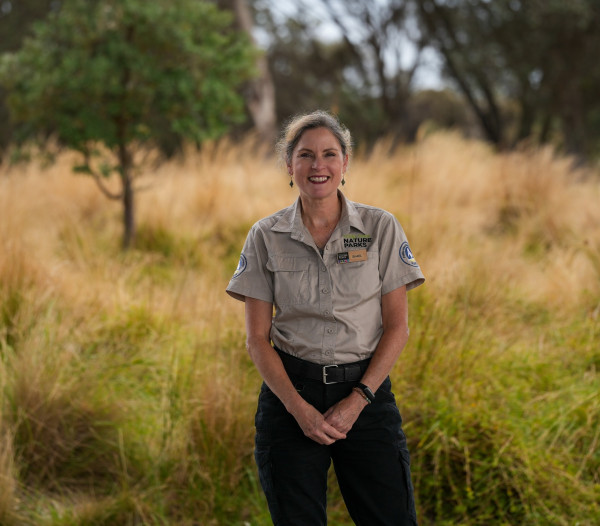
Welcome to another bumper edition of Conservation news!
As the new incoming General Manager Conservation for Phillip Island Nature Parks, I would like to extend my sincere thanks to Stuart Murphy who acted in the role for six months during the recruitment and onboarding process . I would also like to express my deep gratitude to all of the Conservation team and our partners who have welcomed and assisted me with settling into the position.
Over the past six months the Conservation team has kicked some big goals as you will read about. I have felt privileged and tremendously proud of the team’s outputs, which are significant considering the relatively small size of our organisation. Phillip Island Nature Parks is truly a global leader in place-based conservation and it is wonderful to be able to share this with you.
Content
- Little penguins
- Research projects
- Australian fur seals
- Future-Proofing Little Penguinsproject
- Koalas
- Bush stone-curlews
- Reserves, vegetation and flora
- Barb Martin BushBank
Wildlife Rehabilitation Centre
Marine species
Little penguins
2025–26 penguin breeding season update
Kat McNamara, Research Officer
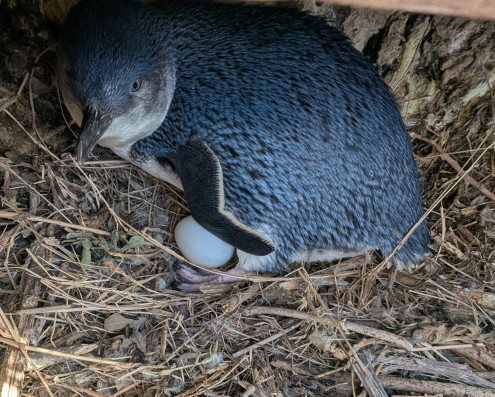
Image 1: Little penguin on eggs
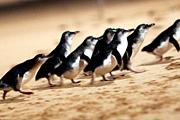
Breeding success of little penguins on Phillip Island (Milawul) is measured through regular monitoring at seven study sites across the Summerland Peninsula, where breeding pairs and their chick-rearing success are closely recorded. Success is measured as the number of chicks raised to fledging per pair, with a long-term average of 1.02 chicks per pair.
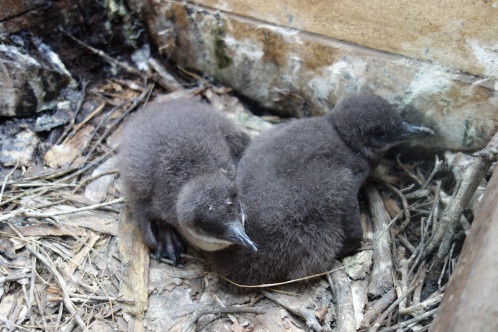
Image 2: Post guard little penguin chicks
The 2025–26 breeding season saw first clutches laid in mid-September 2025. Across the monitoring sites, a total of 169 breeding pairs were observed. Of these, 147 chicks were successfully raised to fledging, giving an overall breeding success of 0.87 chicks per pair. While this sits slightly below the long-term average, it reflects the natural variability that characterises little penguin breeding, which is sensitive to a range of environmental and oceanic conditions that shift from season to season.
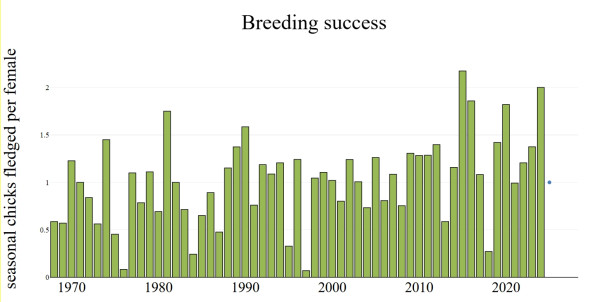
Figure 1: The long-term breeding success of little penguins over time. The blue dot is the long-term average.
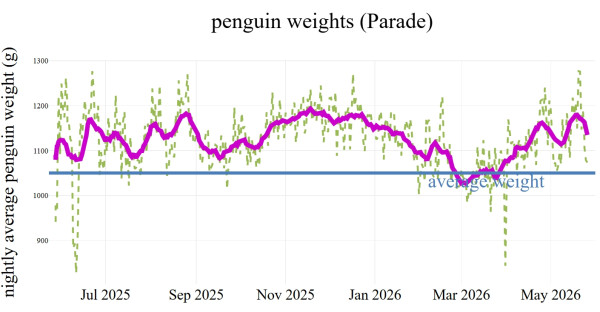
Figure 2: The average weight of little penguins crossing the Penguin Parade Automated Penguin Monitoring System from July 2025 to May 2026. The solid blue linerepresents the long-term weight average (1050 g), the dashed line is the nightly mean weight, and the pink line is the 14-day rolling weight average.
Each year, following the breeding season, little penguins go through what is known as a catastrophic moult, a complete replacement of their feathers in approximately 17 days. While the moult typically peaks between February and March, some individuals can begin as early as January and as late as May. Nightly average weights recorded at the Penguin Parade dropped to their lowest point in March 2026 during the moult, before recovering steadily through autumn. Unable to return to the sea without waterproof plumage, little penguins remain on land and fast for the duration of the moult. In the weeks leading up to the moult, they feed intensively at sea for 2 – 5 weeks, nearly doubling their body weight in preparation. As the new feathers grow in beneath the old ones, the emerging plumage gradually pushes the existing feathers out until their sleek new coat is complete.
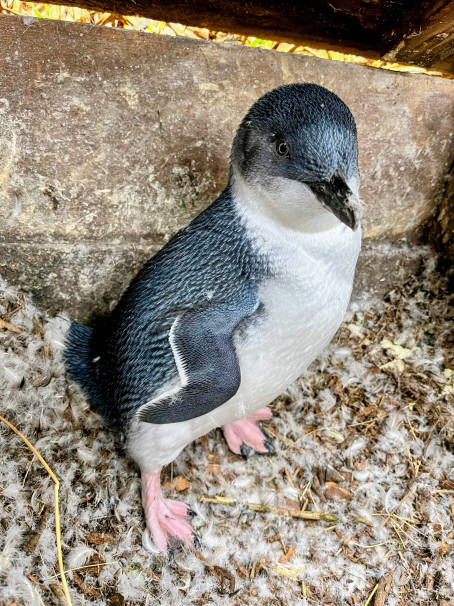
Image 3: Newly moulted little penguin
Research projects
Andre Chiaradia, Senior Scientist
Our long-term research on little penguins reveals how this iconic species is responding to environmental change and what is needed to ensure future resilience. Drawing on some of the world's longest-running little penguin monitoring programs, the Nature Parks researchers and a team of international collaborators analysed more than 10 years of tracking data and found that little penguins consistently return to productive feeding grounds east of Phillip Island
(Milawul), while remaining highly adaptable in how they use these habitats. Rather than relying on fixed feeding locations, little penguins adjust their movements in response to changing ocean conditions and prey availability, maximising foraging success in an increasingly variable marine environment. See our publication list to learn more.
Long-term studies have also shown that individual differences play a critical role in population resilience. Research led by PhD researcherJustine Wintz, who analysed data from little penguins throughout their lives, found that chicks experiencing favourable growth conditions are more likely to survive, recruit into the breeding population earlier, and achieve greater reproductive success as adults. Studies of breeding behaviour revealed that individuals differ markedly in the timing of reproduction, with earlier breeders generally producing more offspring and contributing disproportionately to population growth. These findings demonstrate that conditions experienced early in life can have lasting consequences for lifetime fitness and population dynamics.
PhD researcher Julia Braga's research at St Kilda demonstrated the important role that river systems play in shaping little penguin foraging ecology and breeding success. Her work showed that river-driven productivity can influence prey availability, breeding performance, and population dynamics, and she also developed innovative approaches for monitoring little penguin populations using citizen science, thermal imaging, and autonomous ocean technologies.
Integrating autonomous sailingdrone and eDNA technologies to monitor little penguin prey
During 2025–26, researchers continued to use an autonomous sailing drone equipped with scientific echosounders to investigate the prey resources supporting little penguins in Bass Strait. The drone surveyed large areas of ocean around Phillip Island (Milawul) and collected detailed information on the location, depth, aggregation and density of fish schools. These data formed a key component of Dr Lilia Guillet’s PhD research, which used autonomous sailing drones equipped with scientific echosounders to measure the distribution and behaviour of fish prey at unprecedented spatial and temporal scales.
To complement the acoustic surveys, French bioengineer Marion Delcourt developed and tested environmental DNA (eDNA) methods to identify marine species from genetic material suspended in seawater. Although echosounders can accurately detect fish schools and map their distribution, they cannot identify the species present. The eDNA trials established protocols for seawater collection, filtration and DNA extraction, laying the groundwork for future studies that connect species composition with acoustic measures of prey abundance and distribution.
Together, these technologies provide new opportunities to better understand the marine food web that support Phillip Island (Milawul) little penguins. By combining information on where prey occurs, how it is distributed, and which species are present, researchers are improving their ability to identify the environmental conditions that influence little penguin foraging behaviour, breeding success and population dynamics.
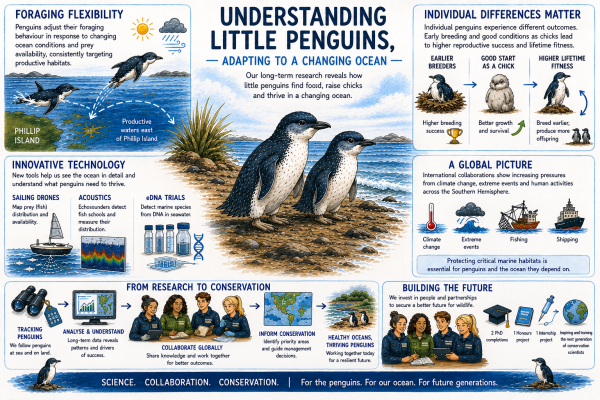
Figure 3: A snapshot of the research helping protect little penguins in a changing environment.
Australian fur seals
Rebecca McIntosh, Senior Scientist, Research team
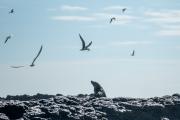
The 2026 SealSpotter Challenge was hosted from 8–21 June with great success using images taken by drone to monitor the numbers of fur seals and their pups every breeding season (November – January). There were 1,390 images uploaded for both sites and each image was counted multiple times so that we can obtain the best seal count per image.
A total of 218 participants counted 10,550 images to understand the pupping success at two of the largest Australian fur seal breeding sites, Seal Rocks and The Skerries. Participation was mostly from Victoria, Australia, but also included people from the Czech Republic, India, Namibia, the Netherlands, Russia, Spain and the United States of America. We are currently analysing the results and will share them publicly soon.
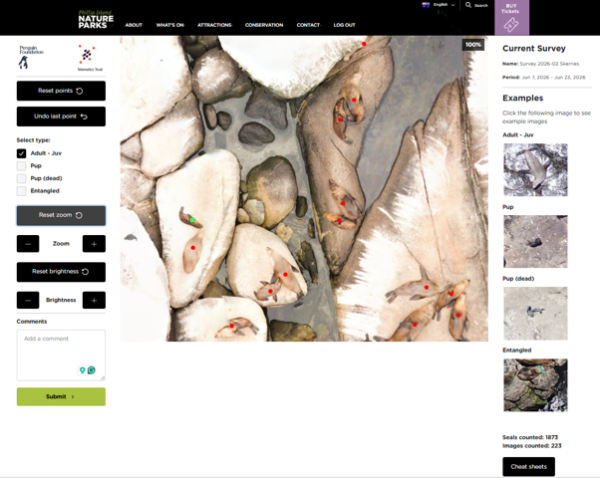
Image 4 – An example image count from SealSpotter of Australian fur seals at The Skerries.
Wildlife Management
Future-Proofing Little Penguins Project
Simon Heislers, Project Coordinator, Summerland Peninsula, Reserves Team
The three-year ‘Future-Proofing Little Penguins’ project', which began in 2023, has now effectively concluded. The Penguin Foundation and the Nature Parks have committed to continue this work for another three years to restore little penguin habitat on the Summerland Peninsula.
Over the past three years, we have gained valuable insights into the challenges of revegetating and restoring habitat in a landscape dominated by hyperabundant herbivores. We have identified key knowledge gaps and begun addressing them, reset expectations about what can realistically be achieved under current conditions, developed more effective conservation practices, and adjusted conservation plans to reflect this improved understanding. However, there is still much more to learn, and importantly, to achieve.
The ‘Little Penguin Resilient Landscape’ project, funded by the Penguin Foundation, builds on the ‘Future-Proofing Little Penguins’ project but with a stronger focus on restoring heavily degraded areas of little penguin habitat and includes a new conservation research trial on the peninsula’s south coast at the southern end of Mandeville Road. The new trial will compare the effectiveness of different land management treatments used to help restore degraded little penguin habitat, assess how dominant herbivores affect restoration efforts and the broader environment, and inform the development of more effective habitat restoration methods.
The project site is close to the coast and within the core little penguin colony area, but it stands out in the landscape because it is almost entirely dominated by exotic pasture grass and looks more like a farm paddock than native vegetation. The site regularly attracts large numbers of Cape Barren geese and is open to other herbivores including the large local wallaby population. Little penguin use of the site is currently low, but nearby high-quality habitat supports dense little penguin populations and once restored, the site could support hundreds of little penguins.
There are many other smaller similar degraded areas within the Summerland colony and finding effective ways to restore them presents a great opportunity to significantly improve native vegetation condition and habitat quality across the Summerland Peninsula.
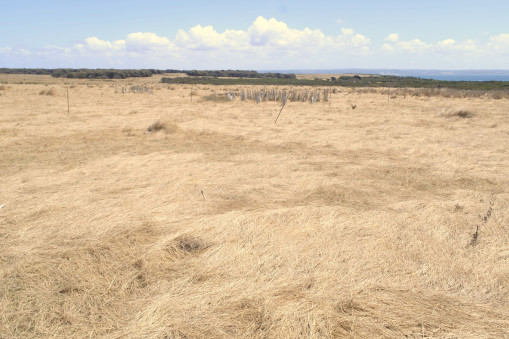
Image 5: Degraded little penguin habitat/exotic grassland and site of the new 'Little Penguin Resilient Landscape' project trial, January 2026.
Koalas
Lachlan Sipthorp, Senior Ranger, Koala Conservation Reserve
Koala Conservation Reserve has completed the development of a new 1.4 hectare plantation on the pre-existing Crook's block. Planting will commence over the next four years to establish additional trees for koala feed at the Koala Conservation Reserve and the volunteer team at Barb Martin Bushbank are currently propagating various eucalyptus species to support this work.
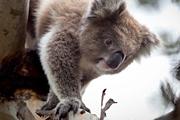
Eleven wild koalas have come into care with the Nature Parks over the past six months. These koalas came from different areas across Victoria. Some have been released back to their point of origin after completing their rehabilitation and several individuals remain in care.
Wildlife Rangers from the Nature Parks have also assisted Parks Victoria with koala catches and health checks on French Island over the past few months. Working with other conservation agencies supports sharing of knowledge and builds capacity of the teams that care for our important native wildlife.
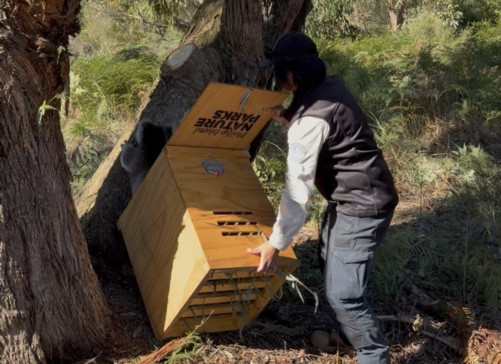
Image 6: Ranger Blair releasing Mimosa the koala back to Outtrim.
Bush stone-curlew release
On 24 June, the Nature Parks released 14 bush stone-curlews in the wild on Phillip Island (Milawul) as part of the landmark reintroduction program for this Critically Endangered species in Victoria.
The newly released bush stone-curlews have joined the other wild birds and this will hopefully encourage more breeding and contribute to a diverse genetic population in the long term, giving us the best chance of success to establish a sustainable population in a changing environment.
The captive birds from Phillip Island (Milawul) have been sourced from sanctuaries around Australia, including Alice Springs Desert Park, Australian Reptile Park, Byron Bay Wildlife Sanctuary, Caversham Wildlife Park, Currumbin Wildlife Sanctuary, Featherdale Sydney Wildlife Park, Lone Pine Koala Sanctuary, Oakvale Wildlife Park and Wildlife Habitat Port Douglas.
In the lead up to their release, the bush stone-curlews have been cared for by Rangers at the Koala Conservation Reserve, with support from the Curlew Custodians volunteer team.
In this release only half the birds had their wings clipped, with researchers investigating whether this assists the birds in avoiding the threat of cars. Before this, all birds had their wings clipped so they would stay close to the release zone rather than disperse away from the island. This strategy will test whether this increases their survival rate when there are no resident birds.
The birds are all fitted with tiny GPS-tracking backpacks and identification bands so we can monitor their progress, habitat use, movement patterns, and reproductive success.
We have seen some promising signs and anticipate more wild breeding attempts later this year, with the hope that some of the chicks survive to fledge and begin to establish a self-sustaining wild population on Milawul.
The re-introduction of the species is a collaboration between Phillip Island Nature Parks, Odonata Foundation and The Australian National University, with support from the Penguin Foundation.
Visitors to Phillip Island (Milawul) can see bush-stone curlews at the Koala Conservation Reserve and learn more about the reintroduction trial from a passionate team of 17 Curlew Custodian volunteers who assist with food preparation, observations, health checks and educating visitors.
Community support is integral to the success of this trial. Residents and visitors can help support Phillip Island’s bush stone-curlews by:
- Driving slowly, especially between dusk and dawn when birds are most active. Curlews usually do not fly to avoid cars, making them especially vulnerable.
- Keeping dogs on a leash and cats always contained.
- Leaving fallen logs on the ground for habitat.
- Reporting curlew sightings at the Victorian bush stone-curlews (Burhinus grallarius) · iNaturalist or via email to community@penguins.org.au
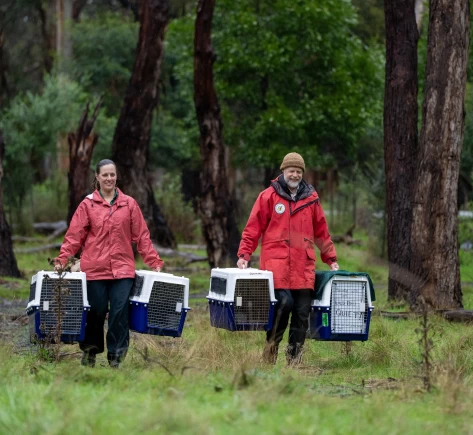
Image 7: Paula Wasiak and Dr Duncan Sutherland carry bush stone-curlew to the release site.
Flora
Reserves Management Program
Seabird Habitat Resilience Project (H5N1)
Mark Merryful, Reserves Senior Ranger
As part of the ‘Seabird Habitat Resilience Project ‘(H5N1), the weed mapping across Cape Woolamai is now complete, covering almost 200 hectares. This level of recording ensures that the field crew can control weeds by targeting precise locations, conduct follow-up evaluations on weed control effectiveness after treatment and identify new infestations that emerge in the landscape.
The San Remo block has been sprayed in preparation for revegetation, and kikuyu along the alignment has been slashed. Woody weed control has begun, progressing systematically from Magiclands towards the Pinnacles, while marram grass control was undertaken from Magiclands through to Anzacs Carpark on Woolamai Beach. Sea spurge control has also been undertaken and will continue. The Nature Parks is trialling a biological control vector for African boxthorn, developed by the CSIRO and the team will undertake ongoing monitoring across the various sites.
At Ventnor, weed mapping was completed across five hectares in the short-tailed shearwater colony alongside kikuyu control at this site. At Observation Point, marram grass has been slashed and controlled in preparation for site revegetation, and woody weed control targeting polygala has also been completed.
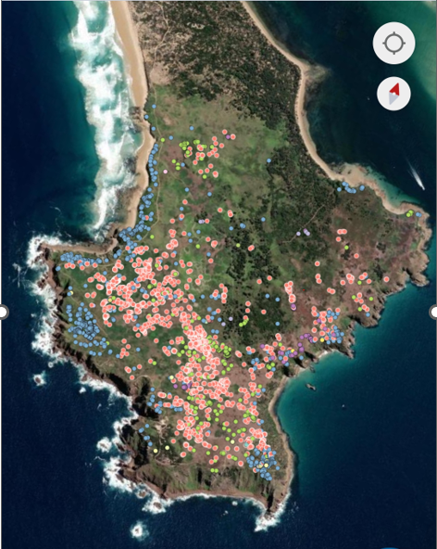
Image 8: Weed mapping at Cape Woolamai. Dots represent weed species and location.
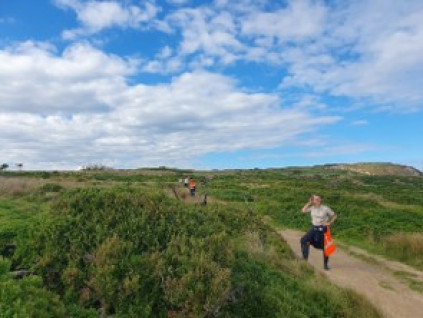
Image 9: Rangers preparing to undertake weed mapping at Cape Woolamai.
Weed control has been undertaken across much of the reserve network, including kikuyu control on the Summerland Peninsula by in-house teams and contractors, tall wheat grass control at Fishers Wetland, and woody weed control at Conservation Hill, Oswin Roberts Reserve, Ventnor Koala Reserve and the Summerland Peninsula. Gorse control has also been carried out across the park, along with sea spurge control at Thornys and Hutchinson Beach.
Revegetation works include planting 100 moonah trees on Churchill Island, 500 plants at Radio Tracking Bay, and 670 plants along the creek at the Penguin Parade to support degraded and erosion-prone areas.
Redundant infrastructure has been removed across several reserves, including old coops at Five Ways Reserve, redundant fencing at Oswin Roberts Reserve, and an old foreshore fence at Smiths Beach, with assistance from our construction team.
Barb Martin BushBank
James Anderson, Environmental Restoration Supervisor
The Barb Martin Bushbank is coming to the end of a large growing season with approximately 50,000 units due to leave the nursery over the next six weeks. Volunteer numbers have been steady with our dedicated team being essential to our increased production.
Retail sales have been steady and we are expecting another year of financial growth. Our focus on providing larger pot sizes and supplying the wholesale market has so far proved successful and is the main driver for financial growth. We have produced 25,000 units for internal revegetation work to support habitat expansion in the shearwater colony at Cape Woolamai.
Threatened flora production is slow and steady and we have more crimson berry stock ready for planting this season. Other species are proving to be popular with the public.
We have also completed our seed collection and processing for the year and this task is increasing in volume and labour year-on-year. It provides us with good stores of seed for coming years and the volunteers as well as Linley have done a fantastic job completing what is a very tedious task.
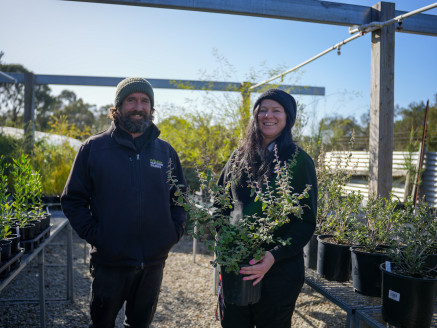
Image 10: James and Renee at the Barb Martin Bushbank
Wildlife Rehabilitation Centre
Brittany Pullin, Senior Wildlife Welfare Officer
To follow up on our last update, we are very happy to report that, after regrowing enough hair and spines for protection, three of the short-beaked echidnas that underwent treatment for skin conditions have been released.
After the unusual number of cases we received, with one individual being a suspected repeat patient, we are working through the process to get permission from the Department of Energy, Environment, and Climate Action to microchip any potential future echidnas that come into care with the same symptoms. This will allow us to ensure the treatment we are providing is effective in the long-term and that we are not repeatedly treating the same echidnas for the same issues.
While this method of identification is more invasive than others, the primary symptom of their condition (spine loss) eliminates other, less invasive options such as adhering a bead to one of their spines. The procedure of microchipping echidnas will be undertaken by a veterinarian while the animal is under anaesthesia to ensure appropriate placement and best practice animal welfare.
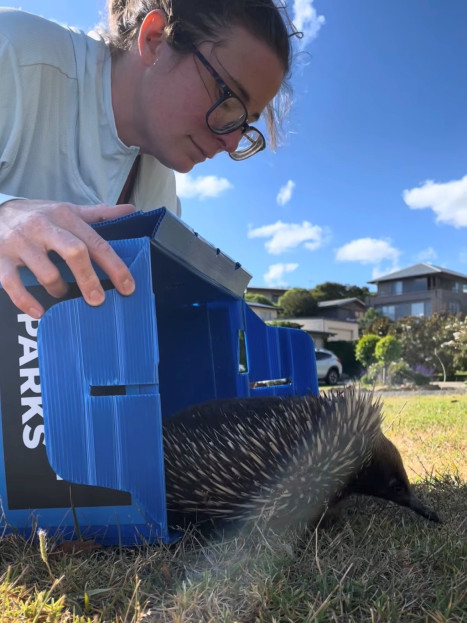
Image 11: Echidna being released with new grown spines and hair.
This season we had a total of six juvenile Australasian gannets transferred to our care from Melbourne Zoo’s Marine Response Unit. These birds each had their own little misadventures before ending up in care, including one individual who recovered from a fractured clavicle. Between our respective facilities, this individual spent almost six weeks in care to allow the bone to heal on its own and can be seen right after take-off below.
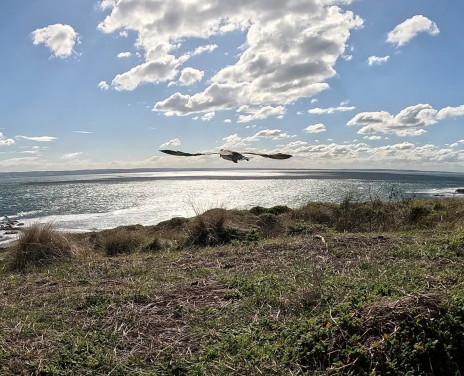
Image 12: A juvenile Australasian gannet is released after healing from a fractured clavicle.
Towards the end of our summer season, we had the pleasure of hosting Mark Kemner, a volunteer with the Southern African Foundation for the Conservation of Coastal Birds (SANCCOB), at the Centre for three weeks.
SANCCOB is an organisation dedicated to the rescue, rehabilitation, and release of seabirds in South Africa and plays a vital role in working to reduce the decline of African Penguin populations. African penguins are currently classified as Critically Endangered, with fewer than 20,000 mature penguins left in the wild, with a high risk of extinction by 2035 if the current trends continue.
One of our own, Ranger Kim was able to spend some time at SANCCOB at the end of last year, after travelling to South Africa to attend a conference on the effects of oil on wildlife. Both Kim’s time there and Mark’s time with us provided a great opportunity to compare each of our respective facilities and the methodology behind our rescue and rehabilitation procedures and techniques. We hope to continue to build and strengthen this relationship and share knowledge to benefit any animals requiring rehabilitation.
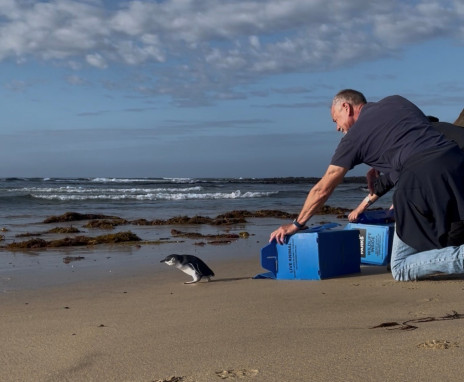
Image 13: SANCCOB volunteer Mark releasing a little penguin
Among attending our usual calls for swamp wallabies, short-tailed shearwaters, and Cape Barren geese, we have attended several calls for brushtail possums trapped in skip bins. Ranger Skye currently holds the in-house record for removing four individuals from one bin. A friendly reminder to ensure lids are always closed when bins are not in use for the health and safety of our native wildlife.
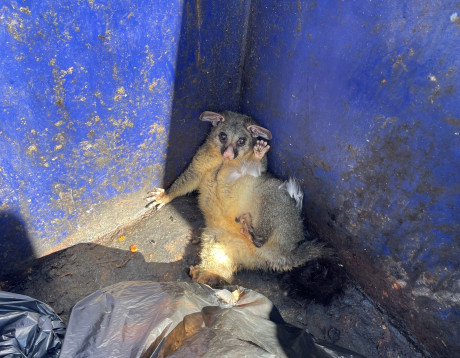
Image 14: A very full juvenile brushtail possum in the skip bin at the Penguin Parade.
If you are ever concerned about an animal being unwell or exhibiting abnormal behaviour, please call Wildlife Victoria’s Emergency Response Service on 03 8400 7300, available 24/7.
Publications
Coetsee, A. L., Sutherland, D. R., Coulson, G., and Hill, R. (2026). The pivotal role of islands in the conservation of eastern barred bandicoots (Perameles gunnii). Proceedings of the Royal Society of Victoria.
Eketone, T. A. M., Rendall, A. R., Coetsee, A., Sutherland, D. R., and Ritchie, E. G. (2026). Experimental evidence of habitat use and activity change of native prey during invasive mesopredator population control. Animal Conservation. doi: https://10.1111/acv.70053
Francis, P., Kelly, R., Swanson, L., Adyel, T.M., Arthur, B., Benkendorff, K., Bishop, M.J., Bostock, H., Campbell, M.L., Church, E., Condie, C., Dwivedi, V., Dyer, M., England, M., Fullbrook, L., Huveneers, C., Johnson, M., Le Busque, B., McIntosh, R.R., et al. (2026). Strengthening ocean literacy: marine science education and training to ensure Australia's blue future. Australian Journal of Maritime & Ocean Affairs, 1-24. https://doi.org/10.1080/18366503.2026.2659436
Guillet, L., A. Chiaradia, N. Joly, B. Dupuis, A. Kato, Y. Ropert-Coudert, M. Chimienti, Y. Hu, R. D. Reina, J. Hentati-Sundberg and C. Saraux (2026). Navigating unpredictable oceans: mapping fine-scale temporal and spatial variability in little penguin foraging areas. Marine Ecology Progress Series 779: 1-21.
Linley, G. D., Sutherland, D. R., and Weston, M. A. (2026). Population suppression of urban common mynas (Acridotheres tristis) by citizens: short-term effects on local avifauna and succession among the despots. Wildlife Research 53, WR25166. https://doi.org/10.1071/WR25166
Loeffler, E., Rendall, A. R., Porch, N., Sutherland, D. R., Coetsee, A. L., and Ritchie, E. G. (2026). The foraging ecology of a threatened ecosystem engineer translocated to island safe havens. Austral Ecology 51, e70168. doi: https://10.1111/aec.70168
McIntosh, R.R., Raum-Suryan, K., Zahniser, D., Barcenas de la Cruz, D., Boren, L., Geut, M., Philipp, C., Hogan, E., Jarvis, D., Johnson, S., Keenan, M., Leonard, J.S., Páez Rosas, D., Raudino, H., Rose, K., Rubio-Garcia, A., Sayer, S., Unger, B., Waples, K., Yaipen-Llanos, C. (2026). The Pinniped Entanglement Group: Standardizing global data for effective solutions to pinniped entanglement. Marine Pollution Bulletin 230, 119801. https://doi.org/10.1016/j.marpolbul.2026.119801
Morais, J. B., A. Chiaradia and R. D. Reina (2026). The influence of rivers on seabird foraging ecology. Biological Reviews doi: 10.1002/brv.70143.
Naccarella, A., Truong, C., Ritchie, E. G., Sutherland, D. R., Coetsee, A. L., and Rendall, A. R. (2026). Mycophagy varies at individual-, population- and site- levels in the diet of a translocated mammal across multiple safe havens. Biodiversity & Conservation.
Radchuk, V., C. V. Jones, N. McLean, A. Charmantier, C. Teplitsky, R. Alisauskas, S. Ancona, T. Anker-Nilssen, P. Arcese, D. Arlt, L. M. Aubry, L. Bailey, C. Barbraud, K. S. Berg, D. Berteaux, D. T. Blumstein, S. Bouwhuis, U. Brose, L. Brouwer, P. Catry, G. Chero, A. Chiaradia, et al. (2026). Changes in phenology mediate vertebrate population responses to temperature globally. Nature Communications 17(1): 479.
Ryeland, J., Tan, L. X. L., Ekanayake, K. B., Rendall, A. R., Sutherland, D. R., van Dongen, W. F. D., and Weston, M. A. (2026). The diet of a coastal omnivorous avian predator as revealed by stable isotope analysis. Wildlife Research 53, WR25075. doi: 10.1071/WR25075.
Taylor, J.J., Huetz, C., Charrier, I., Gray, R.B., McIntosh, R.R. (2026). Passive Acoustic Monitoring and mapping of vessel visitation at an Australian Fur Seal Breeding Colony. Marine Mammal Science 42, e70100. https://doi.org/10.1111/mms.70100
Wille, M., Ross, T. A., Atkinson, R., Boyle, D. B., Christie, M., Dewar, M. L., Douglas, T., Gray, R., Hansen, B., Jessop, R., Kidd, L. R., Marks, I., Mileto, P., Miller, E., Neave, M. J., Ryding, S., Sutherland, D. R., Yu, H., and Klaassen, M. (2026). Migratory bird and marine mammal surveillance fails to find evidence for an HPAI H5N1 2.3.4.4b incursion into Australia in 2025. bioRxiv, 2026.2005.2007.722556. doi: 10.64898/2026.05.07.722556.
Yaney-Keller, A., McIntosh, R.R., Clarke, R.H., Reina, R.D. (2026). Dual colour and thermal drone surveys improves detection of marine debris entanglements in fur seals. Marine Pollution Bulletin 227, 119456.https://doi.org/10.1016/j.marpolbul.2026.119456